

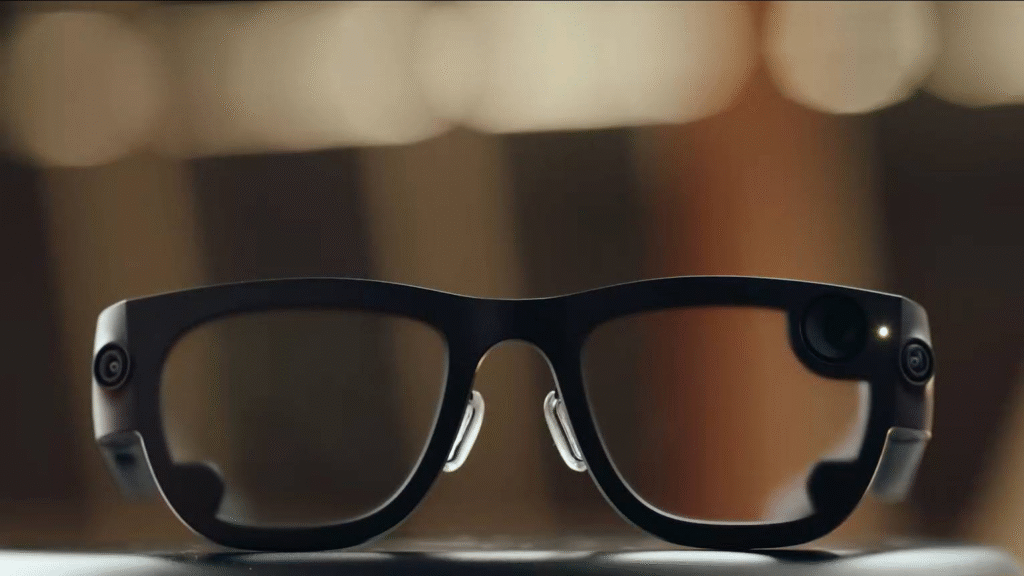
Meta Hypernova appears to be the company’s first attempt at display-equipped smart glasses that feel useful for everyday life. Reports say the device will include a small screen in the right lens and a neural wristband that reads subtle hand motions. The price point that is now being reported makes this product stand out in a market still finding its footing.
What Meta is building and how it will feel to use
Meta is planning a pair of glasses that show simple information in a tiny display placed in the right lens. The display is not meant for full immersive content. It is meant for quick tasks like reading a notification, checking a direction, or seeing a short alert without pulling out a phone.

The company is also pairing the glasses with a wrist-worn band. The band is said to detect electrical signals from small muscle movements. That lets users send simple commands to the glasses without touch or big gestures. The band aims to act as the main control method when precise hand tracking is not possible or would use too much battery.
Taken together, this design tries to deliver useful features while keeping the glasses light and wearable. The device is meant to be a bridge between ordinary smart glasses and much larger augmented reality headsets.
Why the price matters
Initial reporting about the project suggested a price well above one thousand dollars. Newer reports now point to a much lower starting price. This shift in price strategy is important.
A lower price makes the device less risky for mainstream buyers. If Meta positions the Hypernova at a modest premium over a phone, it may tempt more people to try a wearable display in daily life. The device will likely have optional extras such as prescription lenses or a premium frame that add to the final cost. Still, the base price shapes how many people are willing to take the first step into wearing a display.
How Hypernova fits against high-end headsets
Apple has introduced a premium headset that is aimed at immersion and top-notch hardware. That is an expensive, powerful headset. Meta is going another route.
In an area where the high-end headset is aimed more at being an immersive experience, the Hypernova looks to be suited towards small jobs and constant everyday use. It will not substitute a complete headset for gaming or doing 3D. Rather, it wants to be beneficial when individuals are walking, traveling, or working, and they need immediate access to information without the use of a phone.
This can assist Meta to adopt it faster in case the software and the battery performance satisfy the expectations of the users.
The practical features people will notice first
Short notifications and directions must be visible in the line of sight of the users when the product arrives. The gadget is expected to run a pack of lightweight applications and tools. The display can be used alongside a moving arm or camera on the frame capable of framing an individual, face time or prompting swift video calls. A wristband will allow individuals to answer phone calls, pause games, and skip through menus by means of tiny movements.
These are minor and convenient flows that decrease the necessity to access a phone for most regular operations.
Key technical hurdles and user concerns
The idea is simple, but the execution will be hard.
Battery life is the most immediate challenge. Small glasses have little room for a large battery. The product will need careful power management to avoid ending the day with a dead battery.
Privacy and social acceptability will be another core issue. Glasses with cameras or visible displays change how other people feel when they are nearby. Meta will need clear signals to show when the device records or transmits data. It will also need strong controls for users to manage their data and interactions.
Display quality and field of view are also limited. A single small display in one lens is not the same as a full stereo augmented reality experience. That will mean trade-offs for users who expect more immersive content.
App ecosystem and developer support
A small display with limited input will succeed only if useful apps exist. Meta will need partners and developers to build apps that fit the form factor. Navigation, quick replies, short media playback, and contextual alerts are the highest value areas to start.
Integration with a smartphone and with existing Meta services will be important. If the glasses feel like a smooth extension of tools people already use, they will feel more helpful.
Why Meta is taking this route now
The market of wearables has been shifting sluggishly as the initial products were too imperfectly speculative or very costly. Presenting a device that is somewhere in between a smart watch and a full AR headset, Meta will make the technology accessible. This move can enable the business to gather user responses and streamline corrections on its offerings, such as the wristband, creating a superior foundation for future products.
On a business level, the device would also open up the Meta hardware ecosystem, going beyond headsets and tracking devices. It can pave the way to more developed AR devices in the future.