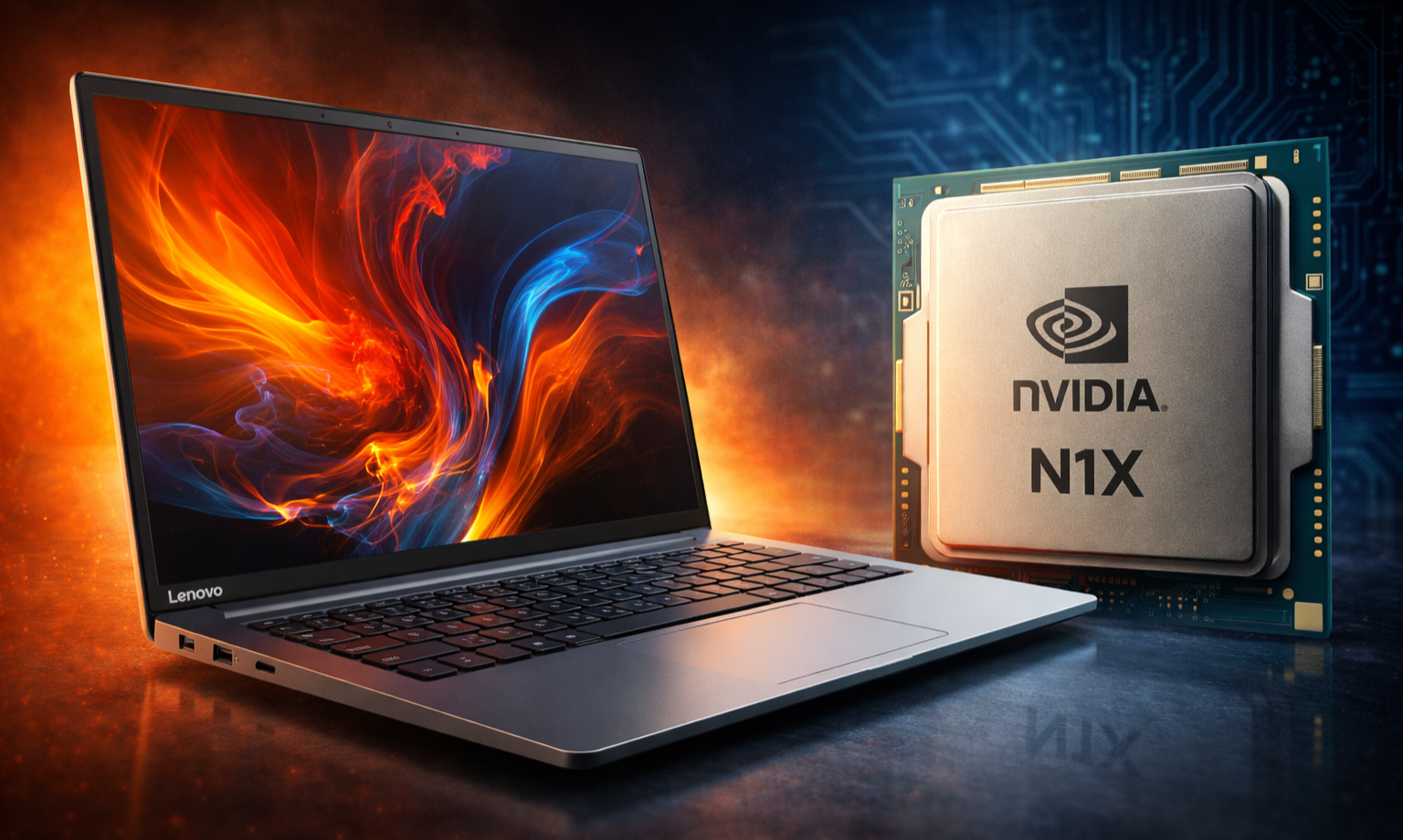

Lenovo is seemingly preparing a series of NVIDIA N1 and N1X system-on-chip laptops. The components would put Lenovo at the leading edge of the first mainstream manufacturers of PCs to distribute genuine Windows on Arm machines designed to play computer games and to create. Early listings and leaks show models named in the Ideapad Yoga and Legion families.
The news matters because NVIDIA is moving from a role as a GPU supplier to a platform supplier that combines Arm CPU cores and a Blackwell GPU on the same chip. The N1X in particular is reported to include a GPU configuration that matches 6,144 CUDA cores in total. That core count matches the desktop-class RTX 5070 on paper and would represent a major step for integrated graphics in laptops. The N1X is also reported to include about 20 Arm CPU cores in some variants.
Lenovo model listings from a data miner show six initial entries that use the N1 or N1X. Some of the models are Ideapad Slim 5 with a 14 and 16-inch on-board, Yoga Pro 7 with two sizes, Yoga 9 2 with one, and a Legion 7 gaming computer. The product codes use an N letter in the naming string that points to NVIDIA as the chip vendor. That pattern has led many observers to mark these as official product plans rather than rumors alone.

What the Chips Offer
NVIDIA N1 and N1X combine Arm CPU blocks with a high-bandwidth GPU. The larger N1X is being discussed as the faster part. Public reporting cites an integrated GPU with 48 streaming multiprocessors and a very wide memory bus. The same report suggests a memory architecture and bridge that allow a lot of bandwidth between CPU and GPU elements. Those parts could enable modern games to run at reasonable settings while keeping overall power use lower than many discrete GPU designs.
Windows on Arm laptops are yet to compete with the x86 machines in terms of gaming performance. An expectation is altered by a chip sporting a Blackwell GPU and 6,144 CUDA cores. Initial standards and prototype versions have indicated good OpenCL and graphics card scores. Manufacturers of laptops have yet to optimize power envelopes and thermals to achieve the optimal frame rate and battery life. Lenovo will face the same engineering task as other manufacturers.
Quick Spec Table
| Model Name Example | SoC Variant | Screen Size | Positioning |
| Ideapad Slim 5 14 N1 V11 | N1 | 14 inch | Thin and efficient |
| Ideapad Slim 5 16 N1 V11 | N1 | 16 inch | Balanced mobile use |
| Yoga Pro 7 15 N1 V11 | N1 | 15 inch | Creator focused |
| Yoga Pro 7 15 N1X V11 | N1X | 15 inch | Creator plus GPU |
| Yoga 9 2 in 1 16 N1X V11 | N1X | 16 inch | Convertible premium |
| Legion 7 15 N1X V11 | N1X | 15 inch | Gaming flagship |
The table is based on the leaked product codes seen in early listings. Names and screen sizes may change when Lenovo announces final models. The table aims to match the leak pattern and to show how the chips map to family lines.
How This Changes Laptop Choices
A strong integrated GPU on an Arm platform lets vendors offer thinner and quieter designs. Many buyers prefer long battery life and light weight. At the same time, some gamers want higher raw performance and are willing to accept thicker bodies. By placing an RTX 5070-class GPU on the same package as the CPU, NVIDIA gives designers another axis to balance thermals and battery life. That could result in a wider set of choices for customers who want Xbox-class experiences on Windows on Arm machines.
Manufacturers must also solve software compatibility and driver work. Windows on Arm needs well-tuned drivers and good support for game engines. NVIDIA will need to deliver drivers and runtime layers that let games run smoothly on the N1 and N1X. Early engineering samples have shown high OpenCL numbers, but final gaming performance will depend on drivers and game developer support.
What to Expect Next
Lenovo listings suggest a launch window soon. Industry roadmaps and other leaks point to a spring release for the first wave of N1 and N1X laptops. Other PC makers are likely to show designs once NVIDIA makes public announcements and ships silicon. Observers will watch battery life numbers, screen options, and how well games run at common resolutions. Early adopters should expect to trade some driver and compatibility risk for access to a new class of Arm-powered laptops that target gaming and content creation.