
Nvidia and Synopsys have confirmed a long-term strategic alliance, which involves an equity acquisition valued at $2 billion by Nvidia and a technical alliance to implement Nvidia accelerated computing and AI into Synopsys engineering tools. The transaction deals with collaborative research in GPU-accelerated AI, agent-driven engineering workflows, and high-fidelity digital twins in order to accelerate simulation and decrease design time of semiconductors and complex systems.
The move is meant to let Synopsys deploy Nvidia software and services inside its simulation and verification tools so engineering teams can run larger or more precise models in less time. Synopsys will use Nvidia CUDA libraries and Nvidia AI physics toolkits to accelerate comput-intensive tasks such as chip design verification, electromagnetic simulation, and molecular modelling. The agreement also links Synopsys AgentEngineer with Nvidia agent tooling and Omniverse to create new agent-driven and visual design flows.
This is not a narrow research program. Nvidia and Synopsys plan cloud-ready solutions that let smaller teams access GPU-accelerated engineering without heavy local infrastructure. The partners will coordinate go-to-market activity so that Synopsys customers can buy or rent these new capabilities through familiar Synopsys channels and cloud providers. The announcement has already changed market sentiment about Synopsys stock, and it underlines how large chip tool vendors expect AI and simulation scale to reshape engineering work.
What Engineers Will See
Engineers should expect three visible changes over the next year. First, common verification runs that once took many hours on CPU farms should complete faster on GPU-accelerated paths. Second, agent-driven workflows will aim to automate routine design steps, to suggest experiments, and to manage tool chains. Third, Omniverse-linked digital twins will let teams validate system-level behaviour in virtual environments that combine software and physics. These changes aim to shorten feedback loops and let teams test more design options before costly fabrication steps.
Practical Impact Now
For chip teams, the short-term payoff is faster iteration on timing and layout checks. For the systems teams, the value is better system-level testing using physics-aware simulations. For both groups, the partnership promises more ready-to-use cloud options so budgets can shift from large in-house clusters to on-demand GPU capacity. The partnership is not exclusive, so Synopsys and Nvidia expect to work within a broader vendor ecosystem.
Cost and Scale
Nvidia purchased Synopsys common stock at a stated price and value that signals a long-term commercial alignment. The investment makes it easier for the companies to invest together in engineering scale-up and to push rapid product integration. Market commentators see the move as a signal that AI-driven simulation will be a major growth area for enterprise engineering tools.
What’s Next
Note early releases with concrete run time and cost examples of real EDA workloads, pilots using Omniverse-based digital twins to test robotics or autopilot testing. Keep track of updates on cloud partners and usages of GPU-accelerated Synopsys services as well. Those practical details will dictate the speed with which experimental use and production use can be relocated to teams.
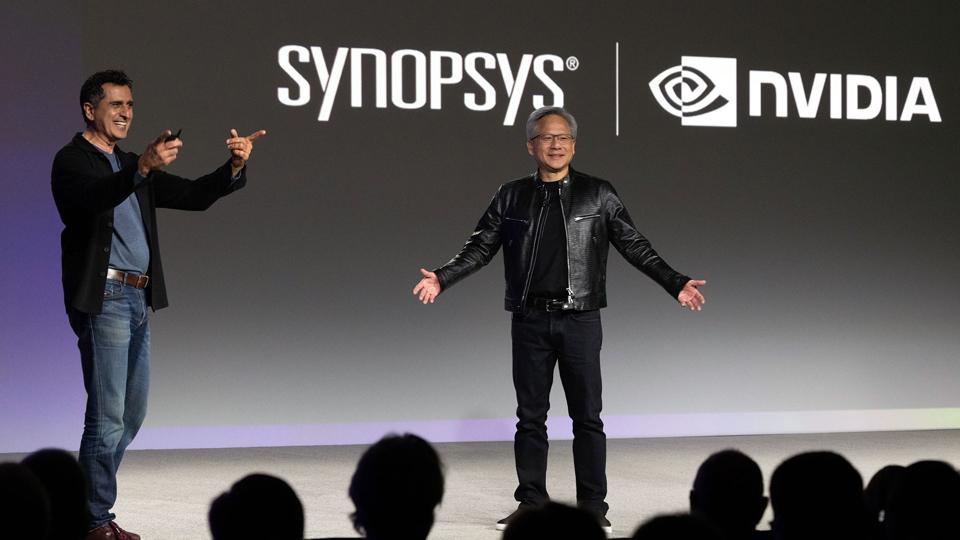
According to Nvidia and Synopsys, the partnership will transform the way engineers do their work by bringing it to tasking simulations and agent-enabled automation into the toolkit, and not a special project. The following months will reveal the rate at which such a change will manifest itself in the day-to-day engineering practice.