

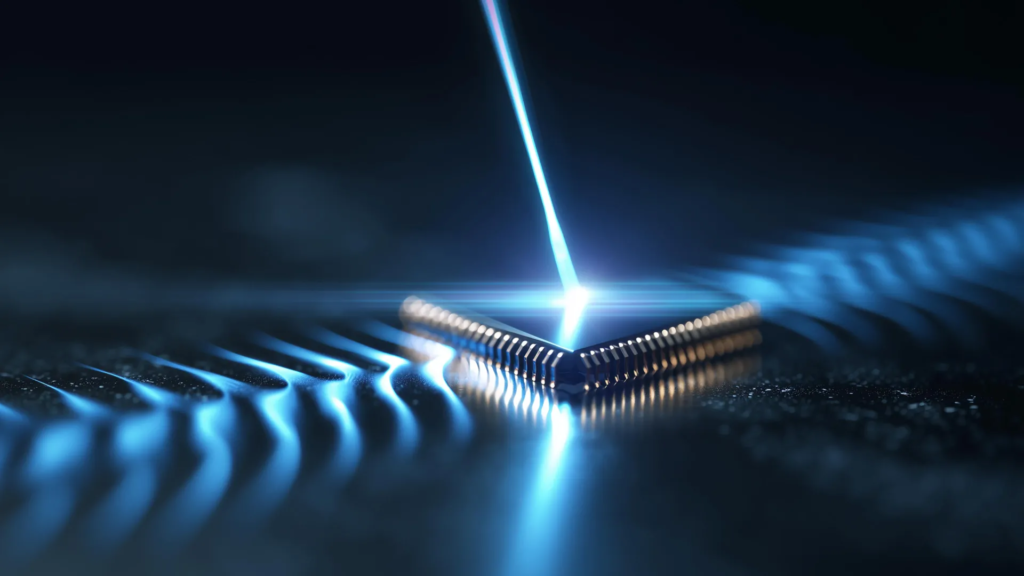
A tiny chip just learned to shake. Engineers built a surface acoustic wave phonon laser that makes microscopic earthquake-like ripples on a silicon chip. The gigahertz device can run at very high speeds as well as push higher. Scientists believe this would allow phone radios to exist on a single chip and consume much less battery power.

Inside the Chip: Function and Impact
A half-a-millimeter-long bar was filled with layers of silicon, lithium niobate, and indium gallium arsenide with a thickness of half a millimeter. That stack turns electrical energy into mechanical surface waves. The waves bounce and grow like a laser, but for sound, not light. The researchers made coherent surface acoustic waves at around one gigahertz and say the design can scale to tens or hundreds of gigahertz. That frequency leap is what makes the idea exciting for radios.
Today, phones use several chips to convert radio waves to small vibrations and back again. That setup wastes space and power. A single chip that can generate and control those surface waves could replace bulky parts. Smaller radio front ends mean fewer parts and less battery drain. The researchers call their device a phonon laser because it amplifies sound quanta in a way similar to how a diode laser amplifies light. The result is an elegant and compact source of very fast surface waves.
Risks, Hype, and the Road Ahead
This is lab-level work, not a phone part you can buy today. The device runs in carefully controlled conditions and uses delicate materials. Scaling to mass production will be hard. Industry must solve manufacturing yield, thermal reliability, and integration with existing radio circuits. Those are predictable engineering fights. The reward if they win is large. Radios could move onto a single chip, and energy-hungry base stations might get a little less greedy. That may change both device design and where companies spend on cloud infrastructure.
There is also a bigger picture. These phonon lasers push the envelope of how engineers use mechanical motion inside electronics. That opens the door to new tricks in sensing, timing, and signal routing. It also raises questions about supply chains and rare materials in the chip stack. The physics looks real, and the data look solid. The timeline for phones is uncertain. Expect prototypes in specialist labs first, then a slow march into commercial radios if partners on the industrial side sign on.
Researchers who built this chip say that it was the last big missing piece for on-chip radio components. If industry backs the idea, the basic radio will shrink, and radios will run cooler and cleaner. That is the promise. The fun part is that the tiny earthquakes on a chip might make our next phones faster and kinder to batteries. That is a future worth watching.