
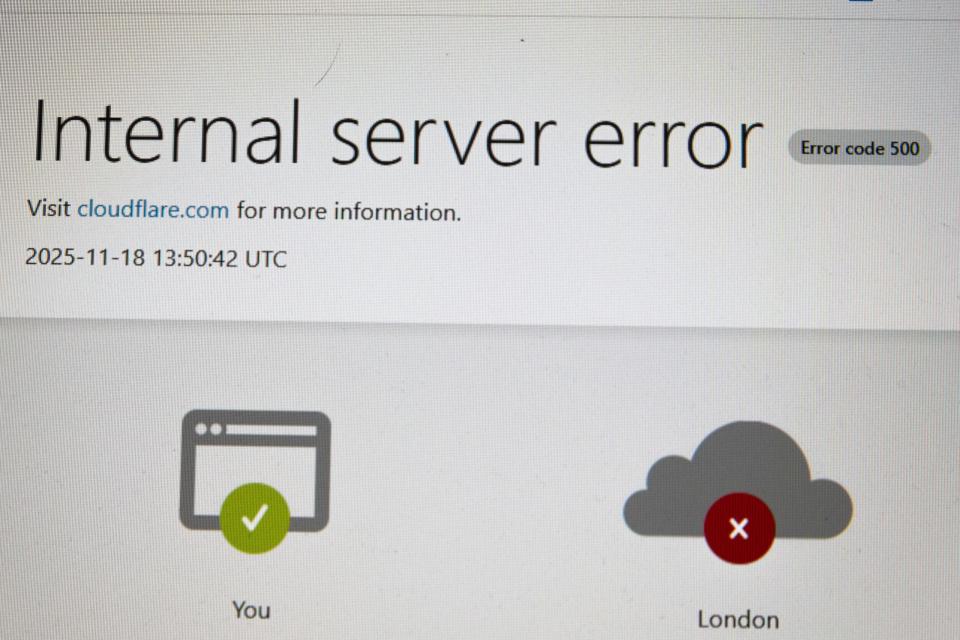

A large-scale internet outage today left millions of people without connection to ChatGPT, X, and several other websites. The outage started at approximately midday and took a majority of users around three hours. Cloudflare attributes the reason behind a large portion of the web going offline to a latent bug triggered by a routine update to its network.
Outage Timeline and Scope
Reports started around 11:30 in the morning in several time zones. Users saw error messages or long loading times when they tried to open X ChatGPT or other popular services. It was observed that outage reports in most countries were increasing at a rapid rate. Big news channels and social feeds were filled with complaints and screenshots of the affected users.

Cloudflare admitted that there was internal degradation and then reported that it had discovered a root cause. The company said a configuration file that manages bot mitigation grew beyond the expected size. That change caused a key service to crash and then to affect dependent services. Cloudflare said the issue was not a malicious attack. The firm rolled out a fix and began monitoring recovery.
The outage touched many services that rely on Cloudflare for traffic routing, security, and content delivery. The impact ranged from full outages to intermittent errors and image loading problems. Some users and tools could access services after repeated refreshes, while others had complete failures. The broad impact showed how a single provider can form a critical part of the internet backbone.
Root Cause and Fix
Cloudflare’s chief technology officer said a latent bug in software supporting the company’s bot mitigation system started to crash after a routine configuration change. The crash spread to the other regions of the network. The company termed the failure unacceptable and apologized to the customers. Engineers made a fix and stated that the services were recovering.
Cloudflare also highlighted an earlier spike in unusual traffic shortly before the outage. The firm emphasized that it sees and blocks malicious traffic regularly and that there is no current evidence the outage was caused by an attack. The company said it will continue investigations and share a public post-mortem.
The timeline and the response show common failure modes in complex cloud systems. A routine update can interact with unexpected data patterns and trigger software failures. The fix involved reversing or changing the configuration and restarting affected services while closely monitoring error rates. Cloudflare said some services may have short-term degradation as traffic flows stabilize.
What This Means for Users and Businesses
When a major provider like Cloudflare falters, many dependent websites show problems at once. For users, the experience is simple to describe. Pages do not load, or functions do not work. For businesses, the impact can be costly. E-commerce platforms, streaming services, and digital tools that depend on the web can lose sales and trust during an outage. Investors also responded with a fall in Cloudflare stock as the market weighed the risks.
The failure once again poses resilience and redundancy problems. Firms can mitigate the risk through the utilization of multiple providers deploying fallback routes, as well as constructing systems that are gracefully degradable. Cloudflare is widely used and convenient, but relying on a single provider can concentrate failure risk. Many organizations will review their architecture and contracts after this event.
How to Stay Informed and What You Can Do
In case a site you visit is offline, visit the service status page to get official information. On platforms that post their own status message,s subscribe to their feeds and the provider status page. The status page by Cloudflare has live updates throughout the incident and will always be the official source of the timeline of the recovery of the company. When there is an outage, users and teams are not supposed to share unverified workarounds that are posted on social media.
It is a good time to test failover plans in companies that operate online. Check that alternative DNS routing plans and caching plans operate properly. Ensure that incident response processes are prepared and that there are templates of communication with customers. The really minor things that can be done beforehand can mitigate the impact when something goes wrong with an infrastructure provider.
Cloudflare will also release a detailed post-mortem after its investigation is complete. That report must give reasons why the configuration file expanded well beyond anticipated bounds, why the failure was not detected sooner, and what measures will be implemented to avoid a failure. Industry observers will be keeping close track since the responses will be important to millions of sites and applications.