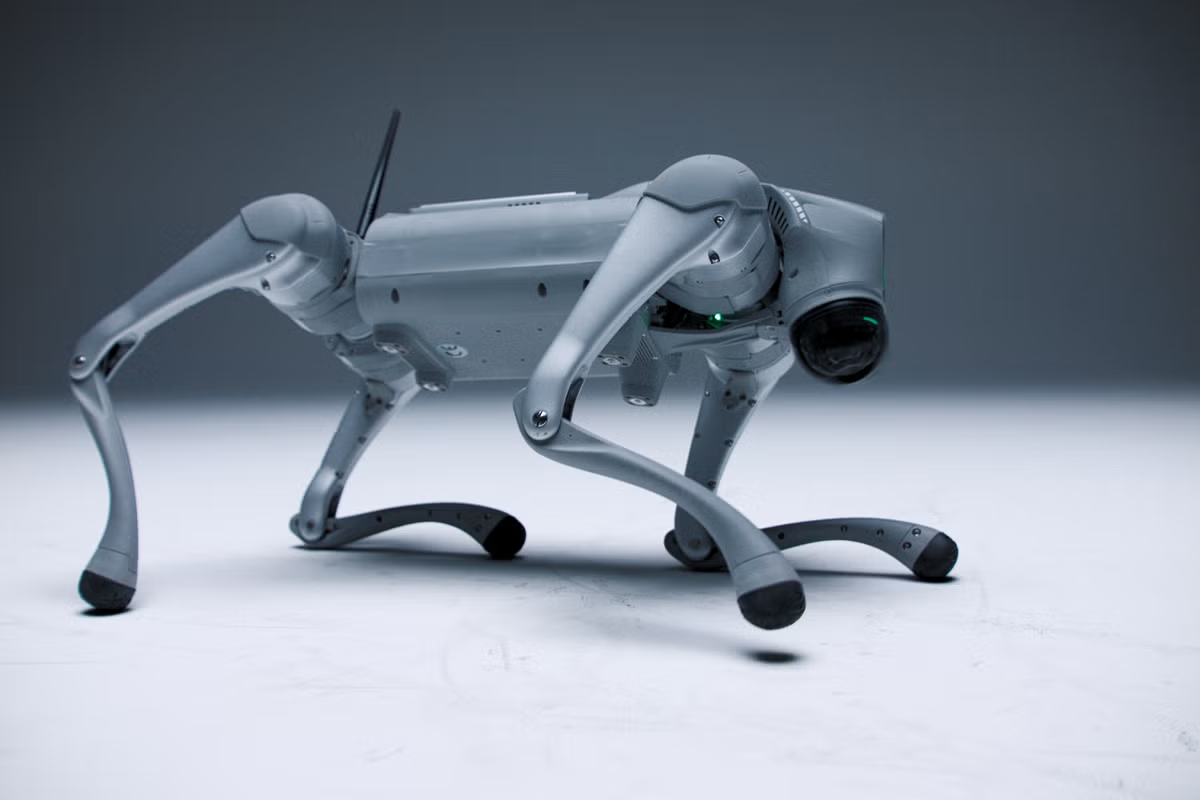

IntuiCell just taught a robot dog to stand and learn on its own. The video makes the point loud and clear. Luna got up without a script and without preloaded brains. The robot learned from touch, motion, and from the real world. That is the kind of thing labs and venture decks promised for years. IntuiCell claims it did it by turning decades of controversial neuroscience into a working learning brain. The company says its system does not rely on giant data sets or endless offline training. It learns while it lives.
Lab Pariahs Become Robot Parents
IntuiCell grew from thirty years of contrarian research at Lund University. The science sat on the sidelines for years. Funding was scarce, and the papers rarely reached top journals. That did not stop the neurophysiologists from asking a blunt question about how brains predict the world. The answer they found is not tidy. It is messy, local, and continuous. IntuiCell translated that work into code and neurons. Viktor Luthman joined as chief executive in 2021. He had a history of building startups near bleeding-edge science. His last exit was Premune in 2020. He says he saw contrarian work that felt like a science fiction idea, and he went all in.
The system IntuiCell built is not an imitation. It does not copy the brain with lipstick. It copies learning mechanisms. The company calls those mechanisms neurons and synapses, and a spinal cord module that drives behavior. That spine is the first production component. It is the thing that lets Luna stand, explore and learn. The method breaks a common rule of modern AI. Most systems separate training and inference. IntuiCell does not. Learning continues as the robot acts. The system forms predictions from raw sensations. It solves local problems on the fly. Luthman says that is how real minds grew from single cells to people who kick balls at seven years old.
Tiny Neurons Mean Big Trouble
IntuiCell is not trying to sell an app. The company sells infrastructure. The pitch is blunt. Build a brain. Put it on service robots, space bots, and underwater machines, and delivery drones. Let the agent learn on-site and adapt to every messy environment that humans cannot preprogram. That is the promise. Luna learned to stand using a few thousand neurons on off-the-shelf GPUs. The company says it does not need planet-sized data centers. It claims that a few hundred neurons were enough for engine anomaly detection across different motors. That demo came from a feasibility study with ABB in the SynerLeap program. The system spotted abnormal engine states with no fine-tuning and no pretraining.
The efficiency claim matters. It is a rebuke of the current AI gospel that pushes bigger models and more data. IntuiCell argues that intelligence starts small. An amoeba learns to avoid danger and find a meal. IntuiCell says replicating that kind of learning is a short path to adaptive machines. The company built Luna to show that learning that begins at the smallest scale can generalize. The robot can learn a task in one building and reuse the skill in another without retraining.
This is not a solo hobby project. The technology came from careful translation and validation of old neuroscience. The team calls their approach embodied learning. That means sensors and body matter are part of the brain. The system prioritises real-time feedback. It does local problem-solving. It routes decision power to the part of the system that needs to act. Those ideas scale. IntuiCell says the same principles work for a small robot dog and for agents that monitor engine health or explore alien ground.
The business play is conservative and precise. Luthman says investors are aligned and not pushing for early monetisation. IntuiCell plans to start with two or three high-value projects before opening the platform wider. The company spent years getting neurons, synapses, and learning rules right. The spinal cord module sits at the center of that work. The timeline is cautious. The company wants the foundation to be solid before scale and that discipline is part of the sales pitch.
Pushback and the Real Questions
Sceptics ask the obvious questions. Is this intelligence or a clever trick, and will it scale to complex tasks? How robust are the learned skills, and how safe will they be in human spaces? IntuiCell answers with demos and with an ABB study that suggests real use cases beyond neat videos. The claim that a few hundred neurons can detect engine faults is provocative. It undercuts the idea that only massive networks deliver real-world value. Luthman says that real-world learning and local adaptation will beat training on vast static data sets in many applied settings.
The company faces hard engineering pressure. Sensors fail, and bodies break, and edge deployments require fault-tolerant learning. IntuiCell says it designed learning to be distributed and efficient so that an agent in a disaster zone or on Mars can keep learning without a tether to a cloud. That vision excites investors who want efficient autonomy, and it also worries people who watch jobs and craft disappear behind new machines.
A Future Where Craft Becomes Luxury
IntuiCell sits at an odd place in AI. The work came from scientists who were ignored and from a CEO who loves bold visions. The company also fits a simple investor story. Build a small brain that can generalise across device types, and you can power many robots with one architecture. The risk is economic, social, and ethical. Machines that learn by living will replace many closed-loop automation tasks. That replacement will shift work and will concentrate power in firms that control the brains.
Regulation and governance have not caught up. Nobody has good policies for agents that learn continuously in the field. Nobody has good liability rules for a robot that adapts a behavior that hurts someone. IntuiCell is selling powerful tech into a world that still debates how to label AI-generated images. That mismatch is not new. The speed of deployment matters. So do audit trails and transparency about how learning takes place.

Read the Fine Print in Plain Sight
IntuiCell is not magic or menace alone. It sits at a real physics frontier. The engineering trade-offs are about computational efficiency and about bringing learning to the body. The company documented that Luna runs on a few thousand neurons and off-the-shelf GPUs. That is not trivial. It is an efficiency claim that resets expectations. It also means that the tech could spread without huge infrastructure. That is the real leverage point. A learning brain that fits on modest hardware is both a commercial win and a social challenge.
The company says it will prioritise a few flagship projects before opening the platform. That is sensible. It buys time for safety, and it provides case studies for generalisation. The spinal cord component is the first problem solver, and it shows the architecture in practice. The work is a clear challenge to the data mill approach that drives the most visible AI firms today.