


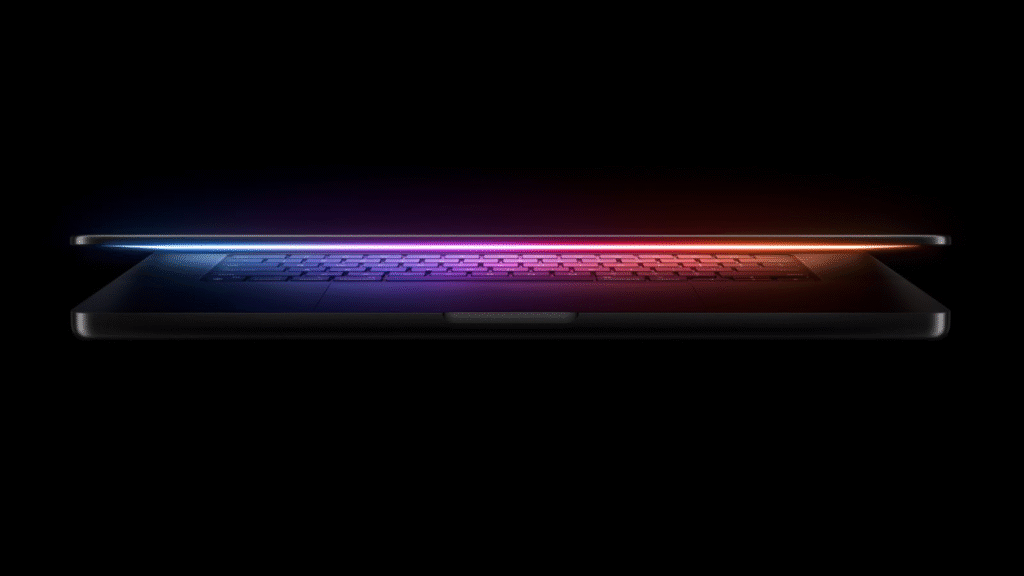
Apple currently considers an attempt to revamp its MacBook Pro line by swapping its existing LCD screens with OLED ones (with Samsung Display as the single supplier). According to industry watchers, the move would not only make the future MacBook Pros more luminous but would also enhance power consumption. Even Samsung Display is currently producing its lines to 8.6-generation OLED, an improvement over the 6th-generation displays in use today.

OLED Technology Shift
The OLED factories with 8.6 generation featured by Samsung Display will be generating bigger glass substrates at a lower cost. It translates to panel dimensions that would accommodate the MacBook Pro 16-inch, 14-inch designs. Apple has requested Samsung Display to join the low-temperature polycrystalline silicon OLED with the oxide thin-film transistors. This combination should cut power draw while boosting peak brightness. Apple’s iPhone 16 uses LTPS OLED today, but adding oxide TFT could reduce power needs significantly.
Samsung Display expects to make 15,000 substrates every month for Apple’s panels. At full tilt, that capacity yields up to 10 million MacBook Pro screens per year. That figure is roughly double what Apple needs, ensuring the supply chain can absorb any early hiccups.
Supply Chain Partnerships
Apple’s two main OLED suppliers are Samsung Display and LG Display, but the new report says Samsung Display will be the sole source for the MacBook Pro in 2026. That aligns with earlier rumors and with Samsung’s historic lead in large-panel OLED. LG Display focuses more on smaller devices today, though it has ramped up OLED production at its sites in South Korea and China.
Meanwhile, China’s BOE aims to fill the gap in iPad displays by expanding its OLED lines. BOE hopes to win orders now that Samsung Display is focused on laptops. Both companies are accusing each other of patent infringement in ongoing legal cases. Apple’s MacBook Air may get OLED as well, but insiders say that model will not switch until 2029. In the meantime, Apple can test the new panels in the Pro line and work out any production challenges without disrupting the volume-minded Air series.